If you've been dealing with stubborn muscle pain, tension headaches, or trigger points that just won't quit, you've probably heard about dry needling.
But what is it really? What does it feel like? And most importantly—does it actually work?
Let's pull back the curtain and walk through exactly what happens during a dry needling session—from assessment to that sweet post-treatment relief.
What Is Dry Needling? (Quick Refresher)
Dry needling is a specialized technique that uses thin, sterile needles to target trigger points—those tight, painful knots in your muscles that cause discomfort, restrict movement, and sometimes refer pain to other areas.
It's not acupuncture. It's based on Western medicine and anatomy, and it's designed to do one thing: release the trigger point and restore normal muscle function.
Now, let's break down what actually happens during a session.
Step 1: We Find the Trigger Point
Every dry needling session starts with an assessment.
We don't just stick needles anywhere. We palpate (press and feel) your muscles to locate the exact trigger point causing your pain. These are the stubborn knots—the spots that make you wince when we press on them.
You might be dealing with:
Tension in your upper traps or neck
A painful knot in your shoulder blade
Tightness in your glutes or hamstrings
Achilles pain that won't let up
Wherever the trigger point is, we find it. And that's where the magic happens.
Step 2: A Thin Needle Is Inserted Directly Into the Muscle
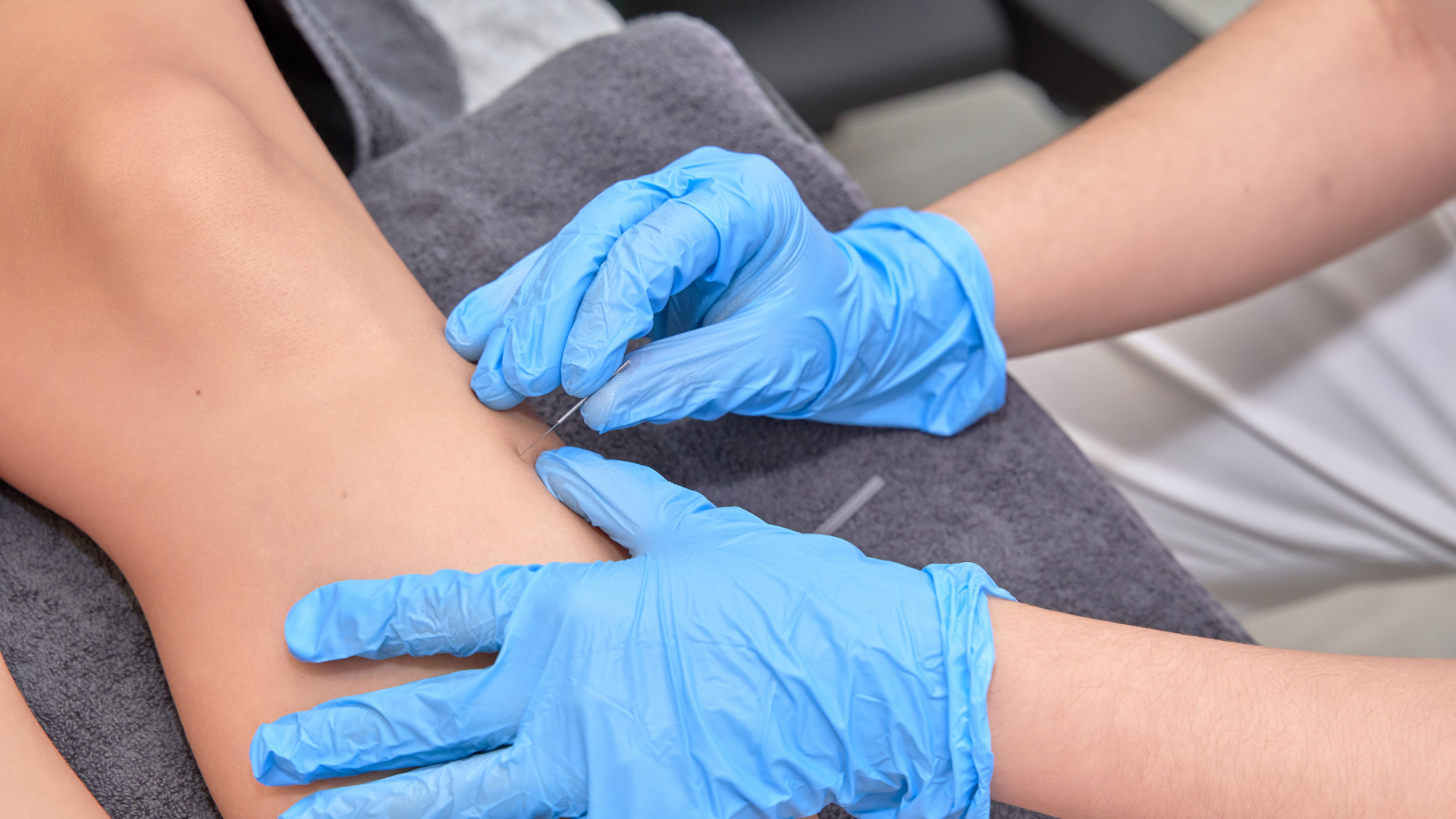
Once we've identified the trigger point, we insert a thin, sterile needle directly into the muscle.
Here's what you'll feel:
A quick pinch (like a mosquito bite)
Sometimes a brief dull ache as the needle reaches the trigger point
The needle itself is incredibly thin—much thinner than the needles used for injections or blood draws. Most people are surprised by how little they feel.
Step 3: Your Muscle "Twitches"—That's the Release
This is where things get interesting.
When the needle hits the trigger point, your muscle may respond with a localized twitch response—a quick, involuntary contraction.
That twitch? That's the trigger point releasing.
It means the muscle is resetting. Blood flow is increasing. Tension is dropping. And you're on your way to relief.
Some people barely feel it. Others describe it as a brief, deep ache or a "grabbing" sensation. Either way, it's over quickly—and it's a sign that the treatment is working.
Step 4: Immediate Relief Starts Flowing In
Once the trigger point releases, many people feel immediate relief—sometimes even while the needle is still in place.
Here's what happens next:
Tension melts away
Range of motion improves
Pain decreases (sometimes dramatically)
You feel lighter, looser, and more mobile
After the session, we may guide you through some gentle stretching or movement to reinforce the release. And then? You're good to go.
So… Does It Hurt?
Let's be honest: there can be brief discomfort.
But here's the thing—compare a few seconds of mild discomfort to months (or years) of chronic pain, and it's a no-brainer.
Here's what most people say:
"That was way less painful than I expected."
"The relief I felt afterward made it totally worth it."
"I'd do it again in a heartbeat."
And remember: you're in control. If something feels too intense, you can communicate with your therapist and we'll adjust.
Who Performs Dry Needling? (Spoiler: Not Just Anyone)
Here's something important: not all dry needling is created equal.
Dry needling requires:
Deep knowledge of anatomy and muscle function
Advanced training in trigger point identification
Skill and precision to safely and effectively treat complex pain patterns
You don't want just anyone sticking needles in your muscles. You want someone who knows exactly what they're doing.
That's why our team includes 3 advanced certified practitioners who have undergone extensive, specialized training in dry needling techniques. We know anatomy inside and out. We know how to find the exact trigger points causing your pain. And we know how to get you results—safely and effectively.
Specialization matters.
What Conditions Does Dry Needling Treat?
Dry needling is incredibly effective for:
✔️ Persistent Shoulder/Neck Tension
Especially from desk work, poor posture, or stress. Dry needling releases the tight muscles in your upper traps, neck, and shoulders—fast.
✔️ Tension Headaches
Often caused by trigger points in the neck and upper back. Release the trigger points, and the headaches disappear.
✔️ Achilles Pain
Stubborn Achilles tendonitis responds incredibly well to dry needling, especially when combined with proper strengthening and mobility work.
✔️ Any Trigger Point Making Life Harder
If you've got a stubborn knot that just won't release—no matter how much you stretch, roll, or massage—dry needling can help.
What to Expect After Dry Needling
Immediately after treatment, you may feel:
Soreness (like you worked out that muscle—because you kind of did)
Increased range of motion
Less pain and tension
The soreness usually resolves within 24-48 hours. And as it fades, the relief sticks around.
Many people notice continued improvement over the next few days as circulation increases and the muscle fully resets.
Why Choose Mobile Dry Needling?
Here's the best part: we come to you.
No driving. No waiting rooms. No stress.
We bring mobile dry needling services straight to your home in St. Louis and St. Charles. You get expert treatment in the comfort of your own space—on your schedule.
Because recovery shouldn't disrupt your life.
Our Team: 3 Advanced Specialists
When it comes to dry needling, expertise matters.
Our team includes 3 advanced certified practitioners who specialize in trigger point therapy and have helped hundreds of patients find relief from chronic pain.
We're not just trained—we're experts. And we're here to help you feel better, move better, and live better.
Ready to Try Dry Needling?
If you've got: → Persistent shoulder/neck tension
→ Achilles pain
→ Headaches that won't quit
→ Any trigger point making life harder
We've got the skills (and the needles) to fix it.
📞 Call or text us at 314-252-0345 to schedule your dry needling session today.
Let's release those trigger points—and get you back to feeling like yourself again.
Mobile Dry Needling | 3 Advanced Certified Practitioners | Serving St. Louis & St. Charles