
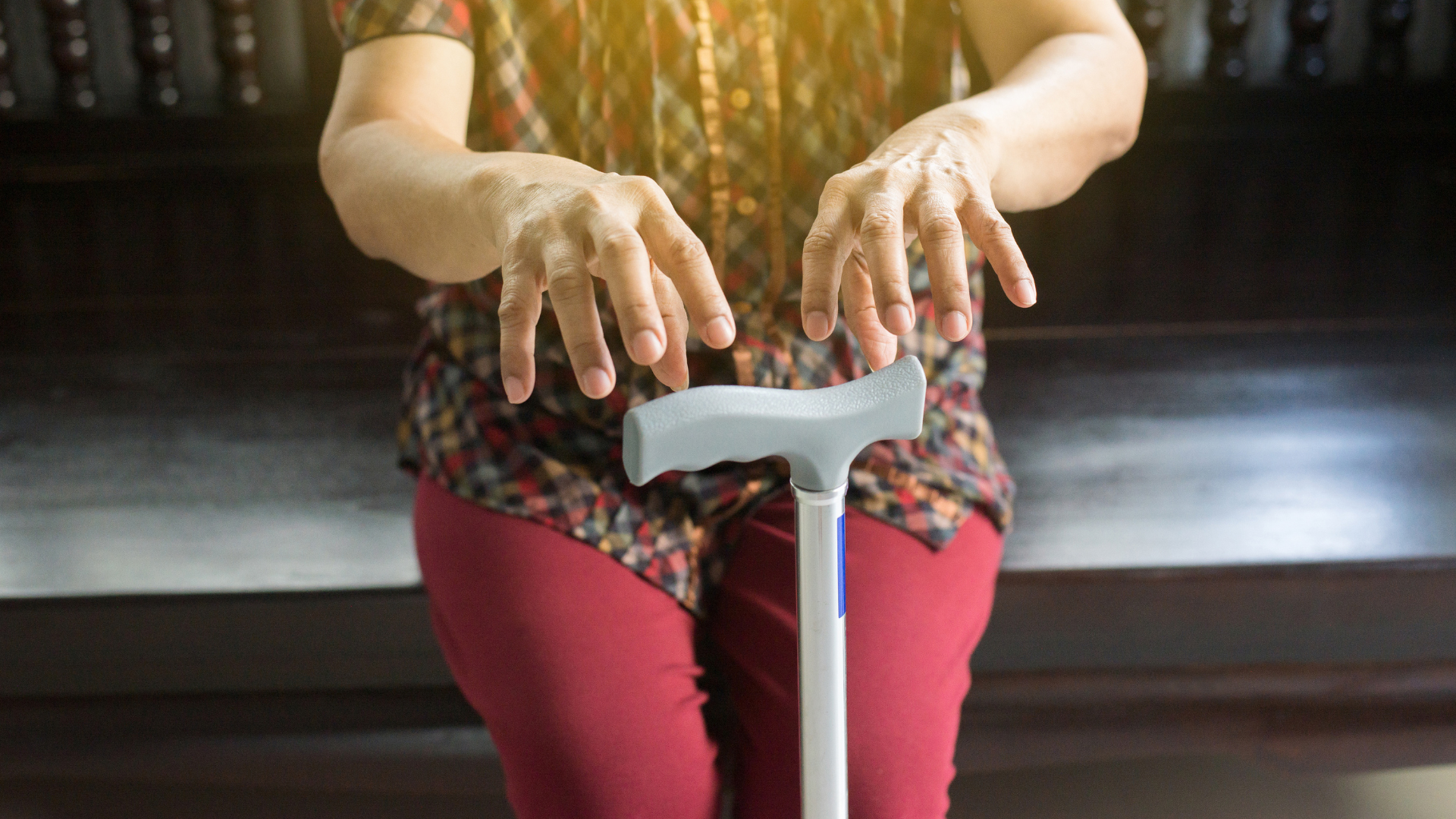
Of all the symptoms that come with Parkinson's disease, freezing of gait is among the most frightening — for the person experiencing it and the family watching it happen.
One moment the person is walking normally. The next, their feet are glued to the floor. The legs stop. The upper body sometimes continues its momentum forward. The fall risk in that split second is significant.
What's Actually Happening in the Brain
Freezing of gait is not a muscle problem. The legs are capable of movement — the signal to move simply isn't getting through. The basal ganglia, a group of structures deep in the brain responsible for initiating and sequencing voluntary movement, is disrupted by the dopamine deficit that defines Parkinson's disease.
The freeze tends to occur at predictable moments: crossing thresholds like doorways, navigating tight spaces, making turns, starting to walk from a stationary position, or walking under time pressure. These transitions require the basal ganglia to generate new motor sequences — exactly the cognitive-motor task it struggles most with in Parkinson's.
Roughly 50% of people with Parkinson's experience freezing of gait, and it becomes more frequent and more prolonged as the disease progresses.
Why External Cueing Works
The most well-researched intervention for freezing of gait is something called external cueing — providing the brain with an alternative signal to initiate movement that bypasses the dysfunctional internal motor generation system.
Visual cues are the most commonly used: lines of tape on the floor, a laser pointer projecting a line ahead of the person's feet, or rhythmic stepping patterns that the person can aim for. The visual stimulus appears to engage a different neural pathway — the premotor cortex — to override the stalled basal ganglia signal and get movement restarted.
Auditory cues work similarly: rhythmic counting, a metronome, or music with a strong, steady beat can help patients initiate and maintain gait when the internal timing mechanism has broken down.
Why the Home Environment Is Critical
Here's the clinical reality: a person can perform beautifully in a wide-open clinical gym with an unobstructed path and a therapist walking beside them. Then they get home, approach their kitchen doorway, and freeze.
The freeze is context-specific. It happens at specific transitions in specific environments. Treating it effectively means working in those environments — identifying the exact doorways, hallways, and spaces where freezing occurs, and implementing cueing strategies that are practical for that specific home layout.
In-home neurological PT allows us to do something clinic-based therapy simply cannot: treat the problem where it actually lives.
📞 Call 314-252-0345 to schedule an in-home Parkinson's PT assessment. Medicare accepted.